At Mozilla, we’ve long believed that technology can be built differently — not only more openly, but more responsibly, more inclusively, and more in service of the people who rely on it. As AI reshapes nearly every layer of the internet, those values are being tested in real time.
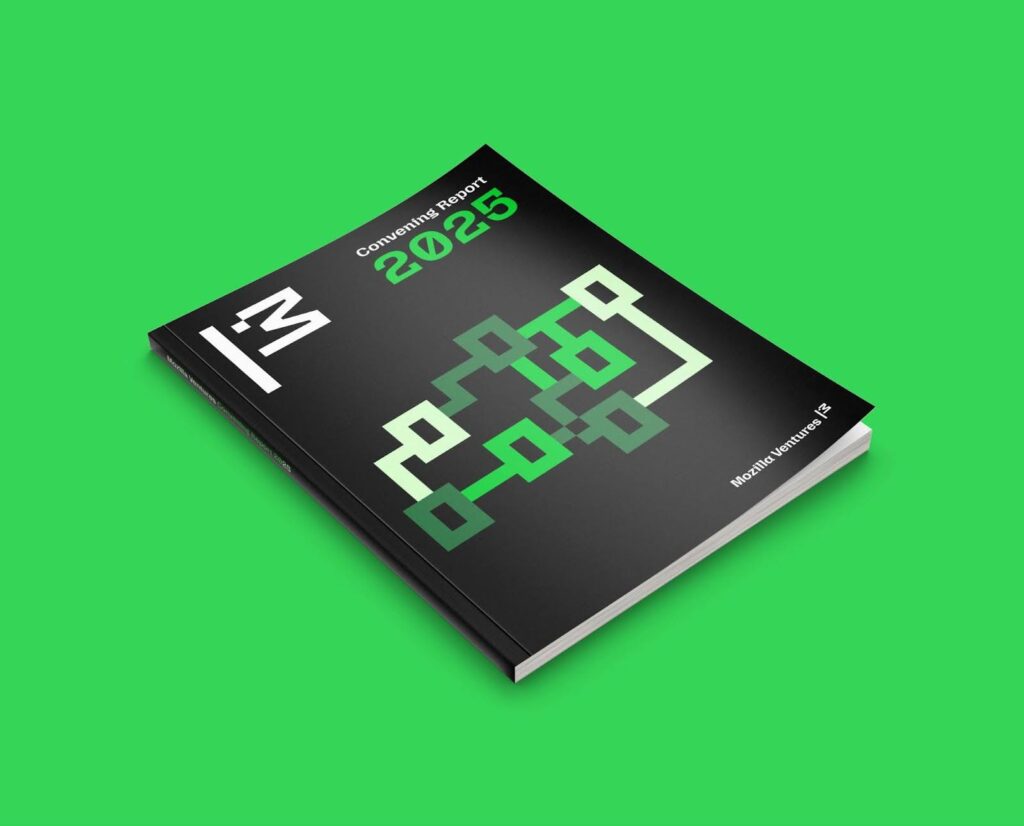
Our 2025 Mozilla Ventures Portfolio Convening Report captures how a new generation of founders is meeting that moment.
At the Mozilla Festival 2025 in Barcelona, from Nov. 7–9, we brought together 50 founders from 30 companies across our portfolio to grapple with some of the most pressing questions in technology today: How do we build AI that is trustworthy and governable? How do we protect privacy at scale? What does “better social” look like after the age of the global feed? And how do we ensure that the future of technology is shaped by people and communities far beyond today’s centers of power?
Over three days of panels, talks, and hands-on sessions, founders shared not just what they’re building, but what they’re learning as they push into new terrain. What emerged is a vivid snapshot of where the industry is heading — and the hard choices required to get there.
Open source as strategy, not slogan
A major theme emerging across conversations with our founders was that open source is no longer a “nice to have.” It’s the backbone of trust, adoption, and long‑term resilience in AI, and a critical pillar for the startup ecosystem. But these founders aren’t naïve about the challenges. Training frontier‑scale models costs staggering sums, and the gravitational pull of a few dominant labs is real. Yet companies like Union.ai, Jozu, and Oumi show that openness can still be a moat — if it’s treated as a design choice, not a marketing flourish.
Their message is clear: open‑washing won’t cut it. True openness means clarity about what’s shared —weights, data, governance, standards — and why. It means building communities that outlast any single company. And it means choosing investors who understand that open‑source flywheels take time to spin up.
Community as the real competitive edge
Across November’s sessions, founders returned to a simple truth: community is the moat. Flyte’s growth into a Linux Foundation project, Jozu’s push for open packaging standards, and Lelapa’s community‑governed language datasets all demonstrate that the most durable advantage isn’t proprietary code — it’s shared infrastructure that people trust.
Communities harden technology, surface edge cases, and create the kind of inertia that keeps systems in place long after competitors appear. But they also require care: documentation, governance, contributor experience, and transparency. As one founder put it, “You can’t build community overnight. It’s years of nurturing.”
Ethics as infrastructure
One of the most powerful threads came from Lelapa AI, which reframes data not as raw material to be mined but as cultural property. Their licensing model, inspired by Māori data sovereignty, ensures that African languages — and the communities behind them — benefit from the value they create. This is openness with accountability, a model that challenges extractive norms and points toward a more equitable AI ecosystem.
It’s a reminder that ethical design isn’t a layer on top of technology — it’s part of the architecture.
The real competitor: fear
Founders spoke candidly about the biggest barrier to adoption: fear. Enterprises default to hyperscalers because no one gets fired for choosing the biggest vendor. Overcoming that inertia requires more than values. It requires reliability, security features, SSO, RBAC, audit logs — the “boring” but essential capabilities that make open systems viable in real organizations.
In other words, trust is built not only through ideals but through operational excellence.
A blueprint for builders
Across all 16 essays, a blueprint started to emerge for founders and startups committed to building responsible technology and open source AI:
- Design openness as a strategic asset, not a giveaway.
- Invest in community early, even before revenue.
- Treat data ethics as non‑negotiable, especially when working with marginalized communities.
- Name inertia as a competitor, and build the tooling that makes adoption feel safe.
- Choose aligned investors, because misaligned capital can quietly erode your mission.
Taken together, the 16 essays in this report point to something larger than any single technology or trend. They show founders wrestling with how AI is governed, how trust is earned, how social systems can be rebuilt at human scale, and how innovation looks different when it starts from Lagos or Johannesburg instead of Silicon Valley.
The future of AI doesn’t have to be centralized, extractive or opaque. The founders in this portfolio are proving that openness, trustworthiness, diversity, and public benefit can reinforce one another — and that competitive companies can be built on all four.
We hope you’ll dig into the report, explore the ideas these founders are surfacing, and join us in backing the people building what comes next.
The post How founders are meeting the moment: Lessons from Mozilla Ventures’ 2025 portfolio convening appeared first on The Mozilla Blog.
Original article written by Mohamed Nanabhay >